Showing posts with label SORTING. Show all posts

Thursday, March 8, 2012

7. RADIX SORT IN C


In computer science, radix sort is a non-comparative integer sorting algorithm that sorts data with integer keys by grouping keys by the individual digits which share the same significant position and value. A positional notation is required, but because integers can represent strings of characters (e.g., names or dates) and specially formatted floating point numbers, radix sort is not limited to integers. Radix sort dates back as far as 1887 to the work of Herman Hollerith on tabulating machines.
Most digital computers internally represent all of their data as electronic representations of binary numbers, so processing the digits of integer representations by groups of binary digit representations is most convenient. Two classifications of radix sorts are least significant digit (LSD) radix sorts and most significant digit (MSD) radix sorts. LSD radix sorts process the integer representations starting from the least significant digit and move towards the most significant digit. MSD radix sorts work the other way around.
6. HEAP SORT IN C

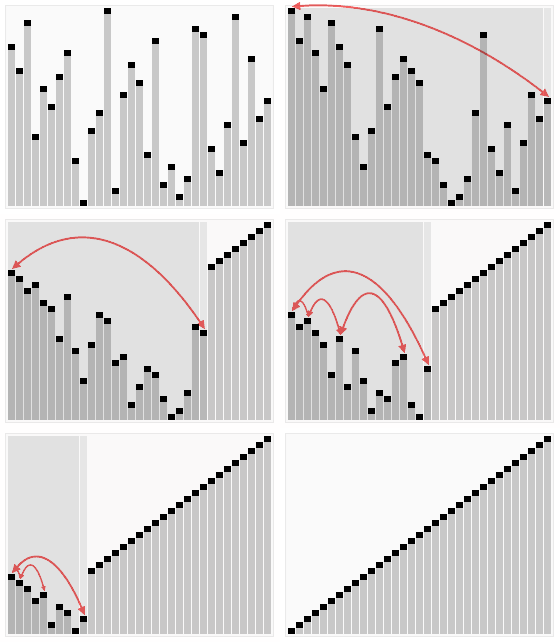
Heapsort is a comparison-based sorting algorithm to create a sorted array (or list), and is part of the selection sort family. Although somewhat slower in practice on most machines than a well implemented quicksort, it has the advantage of a more favorable worst-case O(n log n) runtime. Heapsort is an in-place algorithm, but is not a stable sort.

5. MERGE SORT IN C

Merge sort is an O(n log n) comparison-based sorting algorithm. Most implementations produce a stable sort, which means that the implementation preserves the input order of equal elements in the sorted output. Merge sort is a divide and conquer algorithm that was invented by John von Neumann in 1945. A detailed description and analysis of bottom-up mergesort appeared in a report by Goldstine and Neumann as early as 1948.

4. INSERTION SORT IN C


Insertion sort is a simple sorting algorithm: a comparison sort in which the sorted array (or list) is built one entry at a time. It is much less efficient on large lists than more advanced algorithms such as quicksort, heapsort, or merge sort. However, insertion sort provides several advantages:
  • Simple implementation
  • Efficient for (quite) small data sets
  • Adaptive (i.e., efficient) for data sets that are already substantially sorted: the time complexity is O(n + d), where d is the number of inversions
  • More efficient in practice than most other simple quadratic (i.e., O(n2)) algorithms such as selection sort or bubble sort; the best case (nearly sorted input) is O(n)
  • Stable; i.e., does not change the relative order of elements with equal keys
  • In-place; i.e., only requires a constant amount O(1) of additional memory space
  • Online; i.e., can sort a list as it receives it

3. SELECTION SORT IN C

In computer science, a Selection sort is a sorting algorithm, specifically an in-place comparison sort. It has O(n2) time complexity, making it inefficient on large lists, and generally performs worse than the similar insertion sort. Selection sort is noted for its simplicity, and also has performance advantages over more complicated algorithms in certain situations, particularly where auxiliary memory is limited.